
Build the Future of Product Innovation with an ANSYS Certification Course in India
Introduction: Turn Engineering Ideas into Real-World Solutions
Modern engineering is changing rapidly, and digital simulation now plays an important role in product development. Engineers need more than theoretical knowledge to design reliable products and efficient systems. They must understand how products behave under real-world conditions before manufacturing begins. An ANSYS Certification Course in India helps learners develop practical simulation skills and understand engineering analysis through industry-focused software. From structural analysis to fluid flow and thermal performance, ANSYS supports many engineering applications. Therefore, learning this technology can help students and professionals strengthen their technical knowledge, improve design confidence, and prepare for modern engineering opportunities.
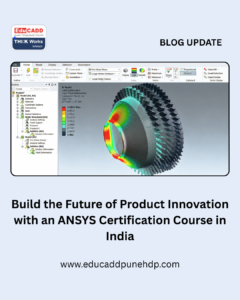
Ansys Certification In India
Part One: Building Strong Engineering Skills with ANSYS
Discover the Power of Engineering Simulation
Engineering simulation allows designers to study product performance before creating physical prototypes. ANSYS provides tools that help engineers examine stress, deformation, temperature, vibration, fluid movement, and other engineering conditions. Instead of depending only on physical testing, engineers can evaluate different design ideas digitally. This approach can reduce development time and support better design decisions. Through an ANSYS Certification Course in India, learners can understand how simulation connects engineering concepts with practical product development. As a result, they can build skills that apply across several engineering industries.
Strengthen Your Understanding of Structural Analysis
Structural analysis is an important area of modern mechanical engineering. Engineers use simulation to understand how components respond to different loads and operating conditions. ANSYS can help users examine stress, strain, deformation, and other structural responses. Learners can also explore how material properties and design changes influence product performance. During an ANSYS Certification Course in India, students can practice creating models, assigning materials, applying loads, and interpreting results. This practical exposure can make complex engineering concepts easier to understand and apply.
Explore Finite Element Analysis with Confidence
Finite Element Analysis, commonly called FEA, is widely used to solve complex engineering problems. The method divides a model into smaller elements so engineers can study its behavior under specific conditions. ANSYS provides powerful tools for performing these simulations and understanding engineering results. Students can learn about meshing, boundary conditions, material properties, loads, and result interpretation. Furthermore, practical FEA knowledge can support careers in product design, automotive engineering, aerospace, manufacturing, and mechanical analysis. This makes simulation training a valuable addition to traditional engineering education.
Learn Through Practical Engineering Projects
Project-based learning can make technical training more meaningful. Instead of studying software commands alone, learners can work on practical engineering models and understand how each tool supports a design task. Projects may include brackets, machine components, automotive parts, assemblies, or other mechanical products. During an ANSYS Certification Course in India, project work can help students follow a complete workflow from geometry preparation to simulation and result evaluation. Consequently, learners can develop both software knowledge and problem-solving abilities that are useful in professional environments.
Understand Thermal and Fluid Applications
ANSYS is not limited to structural simulation. Engineers can also use simulation tools for thermal and fluid-related applications. Thermal analysis helps engineers study temperature distribution and heat transfer. Computational Fluid Dynamics, or CFD, supports the study of fluid movement, pressure, velocity, and related conditions. These applications are important in industries such as automotive, aerospace, energy, electronics, and manufacturing. By learning these concepts, students can understand how different physical conditions affect product performance. This broader knowledge can help engineering professionals approach complex design challenges more effectively.
Develop Better Product Design Thinking
Successful product design requires more than creating attractive geometry. Engineers must consider strength, safety, efficiency, materials, manufacturing requirements, and operating conditions. Simulation supports this decision-making process by allowing designers to test ideas digitally. Learners can modify a design and compare simulation results before selecting a suitable approach. An ANSYS Certification Course in India can therefore help students connect CAD modelling with engineering analysis. This combination can create a stronger foundation for modern product development and simulation-based engineering workflows.
Build Skills for a Technology-Driven Engineering Career
Engineering companies increasingly value professionals who understand digital design and analysis workflows. ANSYS knowledge can complement skills in CAD software, manufacturing, mechanical design, and engineering analysis. Students with simulation knowledge can explore roles related to CAE, design engineering, product development, structural analysis, and simulation. However, software knowledge becomes more useful when learners also understand engineering fundamentals. Therefore, structured training should focus on both concepts and practical applications. An ANSYS Certification Course in India can provide a pathway for learners who want to develop this combination of technical and software skills.
Part Two: Advancing Your Career Through Simulation Expertise
Connect CAD Models with Engineering Analysis
CAD software helps engineers create detailed digital models, while simulation helps them understand how those models may perform. Connecting these two stages creates a more complete engineering workflow. A designer can develop a component and then evaluate its behavior under expected operating conditions. If the results show a potential issue, the design can be modified and tested again. This iterative process supports continuous improvement. Through an ANSYS Certification Course in India, learners can understand how simulation fits into the broader product development cycle and why analysis is important before manufacturing.
Improve Your Problem-Solving Approach
Engineering often involves solving problems with multiple possible solutions. A component may need to become lighter while maintaining strength. A system may need improved thermal performance without increasing its size. Simulation can help engineers compare design alternatives using measurable results. Learners can study different configurations and identify how changes affect performance. Moreover, this process encourages analytical thinking instead of relying entirely on assumptions. ANSYS training can therefore strengthen the way students approach engineering problems and help them develop a more systematic design methodology.
Prepare for Industry-Relevant Engineering Roles
Simulation skills can support career opportunities across several engineering sectors. Mechanical design companies may require engineers who understand structural analysis. Automotive organizations can use simulation for vehicle components and systems. Aerospace companies rely heavily on engineering analysis because product performance and reliability are critical. Manufacturing organizations can also benefit from engineers who understand digital testing and product optimization. An ANSYS Certification Course in India can introduce learners to workflows used in these fields while helping them build practical confidence through exercises and projects.
Enhance Your Professional Profile
A professional profile becomes stronger when it demonstrates practical technical capabilities. Completing structured ANSYS training can show that a learner has invested time in understanding engineering simulation. However, certification should work alongside practical projects, engineering fundamentals, and related software skills. A portfolio containing simulation studies can further demonstrate how the learner approaches real engineering problems. Therefore, students should focus not only on completing a course but also on understanding every project they create. This approach can help them communicate their technical abilities more effectively during interviews and professional discussions.
Learn a Skill That Supports Continuous Growth
Technology continues to evolve, so engineering professionals must keep learning. Simulation methods, digital workflows, and product development practices continue to advance. Learning ANSYS can create a foundation for exploring more advanced engineering analysis topics later. Students can gradually develop knowledge in areas such as nonlinear analysis, dynamics, computational fluid dynamics, thermal simulation, and optimization. Furthermore, experience with one simulation platform can help learners understand broader CAE concepts. Continuous learning can therefore become an important part of long-term professional development.
Transform Engineering Knowledge into Practical Value
The real value of engineering software comes from applying it correctly. Learners should understand why a particular analysis is required, what assumptions influence the model, and how results should be interpreted. Simply generating colourful simulation results is not enough. Engineers must connect those results with physical behavior and engineering principles. An ANSYS Certification Course in India can help learners develop this practical mindset through guided exercises and real-world examples. Consequently, students can move beyond software operation and begin thinking like simulation-focused engineering professionals.
Step Into the Future of Digital Engineering
Digital engineering is creating new possibilities for product development, testing, and optimization. Engineers can now explore design concepts digitally before investing significant resources in physical prototypes. This shift creates demand for professionals who understand CAD, simulation, analysis, and engineering workflows. Learning ANSYS can help students prepare for this changing environment while expanding their technical capabilities. With consistent practice, project experience, and strong engineering fundamentals, learners can build a foundation for future opportunities in design and analysis. An ANSYS Certification Course in India can be an important step toward that goal.
Conclusion: Shape Tomorrow’s Products with Smarter Engineering Skills
The future of engineering belongs to professionals who can combine technical knowledge with digital capabilities. ANSYS offers learners an opportunity to explore simulation, analysis, optimization, and product performance through practical engineering workflows. From structural analysis and FEA to thermal and fluid applications, its capabilities can support many areas of modern engineering. By choosing an ANSYS Certification Course in India, students and professionals can develop valuable software knowledge while strengthening their analytical and problem-solving skills. With practical projects, continuous learning, and strong engineering fundamentals, learners can prepare themselves to contribute to innovative product development and the next generation of engineering solutions.

