
Build the Future of Engineering with an ANSYS Certification Course in India: From Simulation Skills to Industry Innovation
Engineering is evolving rapidly as industries adopt advanced technologies to design safer, stronger, and more efficient products. Today, companies need engineers who can do more than create designs. They also need professionals who can test performance, predict failures, and improve product quality before manufacturing begins. This is where ANSYS plays an important role. An ANSYS Certification Course in India helps students and working professionals develop practical simulation and engineering analysis skills. Moreover, it introduces learners to the techniques that modern industries use to solve complex engineering problems. Whether you have completed mechanical engineering or want to strengthen your technical expertise, learning ANSYS can help you move toward exciting career opportunities. With structured training, practical exercises, and industry-oriented projects, you can build a strong foundation in engineering simulation and prepare for the demands of the modern workplace.
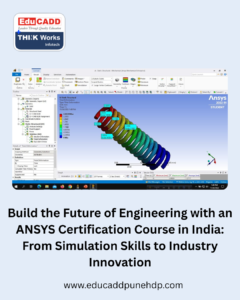
Simulation Skills to Industry Innovation
Part One: Discover the Power of ANSYS and Engineering Simulation
Understand ANSYS and Its Importance in Modern Engineering
ANSYS is an engineering simulation software platform that helps professionals analyze how products and structures behave under different operating conditions. Engineers use simulation to study stress, deformation, temperature, fluid flow, vibration, and other performance factors. As a result, they can identify potential problems before building physical prototypes. This approach saves time, reduces development costs, and supports better design decisions. For example, a mechanical engineer can evaluate whether a machine component can withstand a particular load. Similarly, an automotive engineer can study airflow around a vehicle to improve aerodynamic performance. An ANSYS Certification Course in India introduces learners to these essential concepts and demonstrates how simulation supports real engineering applications. Therefore, students gain a clearer understanding of the connection between engineering theory and practical product development.
Why ANSYS Skills Matter in Today’s Competitive Job Market
Modern engineering companies increasingly depend on digital tools to improve productivity and product reliability. Consequently, professionals who understand simulation techniques can contribute to design validation, troubleshooting, and performance optimization. ANSYS skills are relevant across industries such as automotive, aerospace, manufacturing, energy, electronics, and product development. However, employers also value engineering fundamentals, analytical thinking, and the ability to interpret results accurately. Learning software commands alone may not be enough to solve practical problems. Instead, learners should understand why a particular analysis is necessary and how its results influence design decisions. Through an ANSYS Certification Course in India, aspiring engineers can develop a combination of software knowledge and technical reasoning. This combination can strengthen their professional profile and help them prepare for suitable entry-level or specialized engineering roles.
Explore the Major Applications of ANSYS Software
ANSYS supports several types of engineering analysis, making it useful for different technical disciplines. Structural analysis helps engineers evaluate stress, strain, deformation, and component strength. Computational Fluid Dynamics (CFD) allows them to investigate fluid movement, pressure distribution, and heat transfer. Thermal analysis examines temperature changes and their effects on materials and components. Furthermore, modal and vibration analysis help engineers understand natural frequencies and dynamic behavior. Electromagnetic simulation supports applications involving electric fields, magnetic fields, and electronic devices. Each analysis type addresses a different engineering challenge. Therefore, learners should select training that matches their academic background and career interests. By exploring these applications during an ANSYS Certification Course in India, students can identify the simulation methods most relevant to their future projects.
Develop a Strong Foundation in Finite Element Analysis
Finite Element Analysis (FEA) is one of the most important concepts associated with structural simulation. It divides a complex model into smaller elements connected through nodes. The software then uses mathematical methods to approximate how the model responds to applied loads and boundary conditions. Although the concept may initially seem difficult, practical examples make it easier to understand. For instance, learners can analyze a simple bracket under a force and observe the resulting stress distribution. They can then change the geometry or material properties to study the effects. Nevertheless, accurate results depend on appropriate assumptions, suitable mesh quality, realistic boundary conditions, and correct material data. A good ANSYS Certification Course in India explains these principles step by step. As a result, learners can move beyond operating the software and begin understanding the engineering logic behind simulation.
Learn the Complete Simulation Workflow
A typical simulation project follows a systematic process. First, engineers define the problem and identify the performance requirements. Next, they create or import the geometry and assign suitable material properties. They then generate a computational mesh, apply loads and boundary conditions, and select the appropriate solver settings. After completing the setup, they run the analysis and examine the results. Finally, they validate their findings, identify design improvements, and prepare a technical report. Each stage influences the quality of the final outcome. For example, unrealistic constraints can produce misleading stress values even when the model appears correct. Therefore, learners need to understand the entire workflow rather than focus only on generating colorful result plots. Practical training through an ANSYS Certification Course in India helps students become familiar with this process and develop a more disciplined approach to engineering analysis.
Gain Practical Experience Through Engineering Projects
Practical projects allow learners to apply concepts in realistic situations. Instead of studying only theoretical examples, students can investigate how different loads, materials, and geometries affect product performance. Beginners might start with a cantilever beam, a simple bracket, or a bolted component. Later, they can progress to machine housings, shafts, automotive parts, or thermal systems, depending on their course level. Each project should include a clear problem statement, engineering assumptions, simulation setup, result interpretation, and conclusions. In addition, learners should document why they selected particular parameters and how they checked the results. These activities encourage problem-solving and independent thinking. An ANSYS Certification Course in India that emphasizes guided projects can help students build a portfolio demonstrating their practical abilities to potential employers.
Part Two: Build Professional Skills and Explore Career Opportunities
Choose the Right ANSYS Training Program
Selecting suitable training is an important step toward achieving your learning goals. Before enrolling, review the course syllabus, software modules, trainer experience, practical assignments, and project opportunities. A well-structured program should introduce fundamental concepts before progressing to advanced applications. It should also explain engineering principles alongside software operations. Furthermore, students should check whether the training matches their preferred specialization, such as structural analysis, CFD, or thermal simulation. Beginners may benefit from a course that starts with basic modelling and gradually introduces more complex problems. Working professionals, on the other hand, might prefer specialized modules that complement their existing experience. An ANSYS Certification Course in India becomes more valuable when its learning objectives match your career plans and provide opportunities to practise independently.
Strengthen Your Skills with Industry-Oriented Assignments
Assignments help learners reinforce their understanding and identify areas that need improvement. For example, students can compare two component designs under identical loading conditions and evaluate their relative performance. They might also investigate how material selection affects deformation or how mesh refinement changes the predicted results. These exercises teach learners to ask meaningful engineering questions and support their conclusions with evidence. Moreover, reviewing simulation results against analytical calculations or experimental data, when available, improves confidence in the findings. Trainers can provide feedback on modelling choices, solver settings, and report quality. Consequently, students learn to approach technical challenges systematically. When an ANSYS Certification Course in India includes regular assignments and project reviews, learners receive valuable opportunities to improve their accuracy, confidence, and technical communication.
Discover Career Opportunities After ANSYS Training
ANSYS knowledge can support applications for several engineering positions, depending on a candidate’s education, practical experience, and specialization. Relevant roles may include CAE Engineer, FEA Engineer, Simulation Engineer, Structural Analysis Engineer, CFD Engineer, and Product Design Engineer. Some positions focus on stress analysis, while others involve fluid flow, thermal performance, or product validation. However, completing a course does not automatically guarantee employment. Employers may also expect knowledge of engineering mechanics, material science, CAD software, numerical methods, and industry-specific practices. Therefore, learners should combine simulation training with a strong technical foundation and relevant project experience. An ANSYS Certification Course in India can serve as one part of a broader career-development plan, helping candidates demonstrate their commitment to learning modern engineering tools.
Connect ANSYS with Other Engineering Software
Engineering projects often involve multiple software applications. For instance, a design engineer may create a component in SolidWorks, CATIA, Creo, or another CAD platform before preparing it for simulation. The engineer can then use ANSYS to evaluate the component under expected operating conditions. Based on the results, the design may require modifications before manufacturing. Similarly, simulation findings can support collaboration between design, manufacturing, testing, and research teams. Understanding this connection helps learners appreciate the complete product development cycle. Nevertheless, software integration depends on file compatibility, model preparation, licensing, and the requirements of a particular project. By combining ANSYS knowledge with CAD skills and engineering fundamentals, students can develop a more versatile technical profile and contribute more effectively to multidisciplinary engineering work.
Build a Strong Engineering Portfolio
A well-prepared portfolio gives employers a clearer picture of your practical abilities. Rather than listing software names alone, include selected projects that explain the engineering problem, your methodology, and the results. For each project, describe the model, material properties, boundary conditions, mesh strategy, and important assumptions. Then present the key findings and explain what they mean for the design. Include relevant screenshots and graphs in your portfolio document, ensuring that every figure supports a clear technical explanation. You should also mention any limitations and steps you would take to improve the analysis. Importantly, distinguish academic practice projects from professional assignments and never present simulated findings as experimental proof. An ANSYS Certification Course in India can help you develop suitable project material that demonstrates both your software knowledge and your ability to explain engineering decisions.
Improve Your Employability with Continuous Learning
Engineering technologies continue to develop, and employers expect professionals to keep their knowledge current. Therefore, completing an introductory course should be the beginning of your learning journey rather than its final stage. You can strengthen your skills by studying advanced analysis techniques, practising new models, reviewing technical documentation, and learning from engineering case studies. In addition, improving communication, teamwork, and technical reporting can help you explain complex results to colleagues and clients. Interview preparation is equally important because employers may ask you to explain mesh quality, boundary conditions, convergence, and result validation. By practising these topics, you can present your knowledge more confidently. An ANSYS Certification Course in India, combined with consistent self-learning, can support your progress toward more challenging engineering assignments and specialized technical responsibilities.
Why Choose EDUCADD Hadapsar for Your ANSYS Learning Journey?
Choosing a training institute that understands your learning needs can make the process more effective. At EDUCADD Hadapsar, students interested in engineering software training can explore learning opportunities aligned with their technical and professional goals. Before enrolling in an ANSYS program, ask about the available modules, practical training hours, project structure, trainer qualifications, and assessment methods. You should also clarify which ANSYS products and versions the course covers, because different engineering applications require different tools. If you are a beginner, look for guidance that connects software operations with fundamental engineering concepts. Furthermore, ask how the institute helps learners prepare project portfolios and develop job-related skills. These details will help you assess whether the training suits your expectations. A carefully selected ANSYS Certification Course in India can provide a structured environment for learning, practising, and developing confidence in engineering simulation.
Conclusion: Turn Your Engineering Knowledge into Practical Innovation
The future of engineering belongs to professionals who can combine technical knowledge with analytical thinking and modern digital tools. ANSYS helps engineers investigate product behaviour, evaluate design alternatives, and make informed decisions before manufacturing begins. Therefore, learning simulation can be a valuable step for mechanical engineers, engineering students, and professionals who want to expand their technical capabilities. However, success requires more than software familiarity. You must also understand engineering fundamentals, practise with realistic projects, validate your results, and communicate your findings clearly. By choosing appropriate training and continuing to improve your skills, you can prepare for opportunities in simulation, product development, and engineering analysis. An ANSYS Certification Course in India can help you begin this journey and build a foundation for long-term professional growth. Start learning, practise consistently, and take the next step toward becoming an industry-ready engineer with EDUCADD Hadapsar.

