
Master the Art of 3D Modeling and Product Innovation: Build Your Future with an Inventor Certification Course
Introduction: Transform Creative Ideas into Engineering Masterpieces
Modern engineering depends on innovation, precision, and the ability to turn creative ideas into practical products. From automotive components and industrial machinery to consumer electronics and manufacturing equipment, every successful product begins with a concept. Engineers must transform that concept into a detailed design that meets performance, safety, and manufacturing requirements. This is where 3D modeling and computer-aided design play an essential role. Autodesk Inventor helps aspiring designers and engineering professionals develop digital models, visualize product concepts, and create detailed engineering documentation. By mastering this powerful design software, learners can strengthen their technical abilities and prepare for opportunities in mechanical design, product development, and manufacturing. An Inventor certification course can provide a structured learning path for students who want to build industry-relevant skills and explore a rewarding career in design engineering.
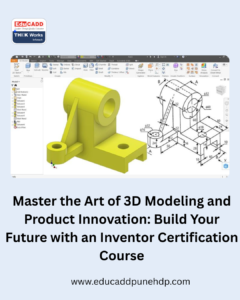
Transform Creative Ideas into Engineering Masterpieces
Part One: Discover the Power of Digital Product Design
From Creative Concepts to Practical Engineering Solutions
Every innovative product begins with an idea, but transforming that idea into a functional design requires technical knowledge and careful planning. Engineers must consider dimensions, materials, component relationships, manufacturing methods, and product performance before production begins. Traditional design methods often require repeated manual revisions, which can consume valuable time. However, modern 3D design tools help engineers visualize their ideas more effectively and identify potential problems early. Autodesk Inventor supports this process by allowing designers to develop accurate digital models and explore different design possibilities. As a result, engineers can communicate their concepts clearly, improve collaboration, and create designs that align with real-world manufacturing requirements.
Understanding the Fundamentals of 3D Modeling
3D modeling forms the foundation of modern mechanical design. It allows designers to represent physical objects through digital geometry, including length, width, height, curves, surfaces, and complex shapes. Unlike a basic two-dimensional drawing, a three-dimensional model provides a more complete understanding of a component’s appearance and structure. Designers can rotate models, inspect features, and evaluate how individual parts may fit together. These capabilities make 3D modeling valuable across automotive engineering, industrial equipment, aerospace, and consumer product development. Learning the fundamentals helps beginners develop spatial awareness, improve dimensional accuracy, and understand how engineering drawings translate into physical products.
Explore the Essential Features of Autodesk Inventor
Autodesk Inventor offers a range of tools for mechanical design, parametric modeling, assembly creation, and engineering documentation. Designers can create sketches, define dimensions, apply geometric constraints, and convert two-dimensional profiles into three-dimensional components. The software also supports advanced modeling operations that help users develop intricate product shapes. Furthermore, its parametric approach allows designers to modify dimensions and update related features efficiently. This flexibility reduces repetitive work and supports organized design development. By learning these features systematically, students can progress from simple components to complex mechanical assemblies and gain practical experience with professional design workflows.
Build Accurate Models with Parametric Design Techniques
Parametric modeling enables designers to control geometry through dimensions, relationships, and design parameters. For example, changing the diameter of a circular component can update its geometry according to the defined design rules. This approach makes revisions easier and helps maintain consistency throughout the modeling process. Designers can also establish constraints that control how sketches behave when dimensions change. Consequently, they can explore alternative designs without rebuilding every component from the beginning. Understanding parametric techniques helps learners develop efficient modeling habits, reduce errors, and manage engineering changes more confidently. These skills are especially valuable when products require frequent modifications during development.
Develop Complex Products Through Assembly Modeling
Most mechanical products consist of multiple components that must work together correctly. Assembly modeling helps designers combine individual parts and define their relationships within a complete product structure. For instance, a gearbox may contain gears, shafts, bearings, a housing, and fasteners. Each component performs a specific function, so the designer must consider alignment, movement, and component compatibility. Autodesk Inventor allows users to organize these parts into assemblies and examine how they interact. Designers can also identify potential interference between components before manufacturing begins. Therefore, assembly modeling improves design understanding, supports troubleshooting, and helps engineers prepare products for further testing and production.
Create Professional Engineering Drawings and Documentation
A detailed 3D model becomes more useful when engineers can communicate its specifications through accurate technical drawings. Manufacturing teams need information about dimensions, tolerances, materials, views, and other essential component details. Engineering drawings provide this information in a standardized format that supports production and quality control. Autodesk Inventor helps designers generate drawing views from three-dimensional models and present essential dimensions clearly. When a model changes, associated drawing views can update according to the design workflow. Learning documentation techniques helps students connect digital modeling with practical manufacturing requirements. It also prepares them to communicate effectively with engineers, machinists, production teams, and project managers.
Part Two: Turn Your Design Skills into Career Opportunities
Enhance Product Development with Sheet Metal and Frame Design
Many industries rely on sheet metal components, fabricated structures, and customized machine frames. These elements require precise dimensions, suitable material thicknesses, and practical manufacturing considerations. Autodesk Inventor provides specialized tools that help designers develop sheet metal parts, create folded components, and prepare flat patterns for fabrication. Frame design tools also support the development of structural assemblies using standard profiles. These features help engineers manage complex designs while maintaining manufacturing accuracy. By practicing these workflows, learners can expand their technical capabilities and understand how digital models support actual production processes.
Understand Simulation and Design Optimization
A successful product must do more than look attractive; it must also perform reliably under expected operating conditions. Engineers need to consider loads, movement, material properties, and potential design limitations. Inventor includes simulation-related capabilities that help users evaluate aspects of product behavior and identify areas for further investigation. For example, designers can examine component motion or perform stress analysis on suitable models. These tools support informed design decisions before physical manufacturing begins. However, engineers must interpret simulation results carefully and validate important findings through appropriate engineering methods. Learning these concepts helps students connect creative modeling with analytical thinking and practical problem-solving.
Build Industry-Ready Skills Through Practical Projects
Practical projects help students move beyond software commands and develop genuine design confidence. Instead of practicing isolated features alone, learners should create complete components and assemblies that resemble real engineering applications. Projects such as a machine vice, bearing housing, pulley assembly, sheet metal enclosure, or small mechanical fixture provide valuable experience. Each project introduces different challenges involving dimensions, constraints, component relationships, and technical drawings. Furthermore, maintaining a portfolio of completed designs helps students demonstrate their abilities during interviews. An effective Inventor certification course should combine software instruction with guided exercises, project work, and feedback that encourages continuous improvement.
Explore Career Opportunities in Mechanical Design
Professionals with 3D modeling and mechanical design skills can explore opportunities across manufacturing, automotive engineering, industrial equipment, product development, and engineering services. Depending on their qualifications and experience, they may pursue roles such as CAD designer, mechanical design engineer, product design associate, or engineering drafter. Employers often value candidates who understand engineering fundamentals, communicate clearly, and produce accurate technical documentation. Therefore, learning Autodesk Inventor can strengthen a candidate’s technical profile, particularly when combined with practical projects and relevant mechanical knowledge. Career progression depends on individual performance, experience, qualifications, and employer requirements rather than software knowledge alone.
Choose the Right Learning Path for Long-Term Growth
Selecting a suitable training program is an important step toward developing professional design skills. Beginners should look for structured lessons that cover sketching, part modeling, assemblies, drawing creation, and practical applications. Experienced learners may benefit from advanced topics such as sheet metal design, frame generation, simulation, and design configurations. Regular practice also plays a major role in building speed and accuracy. In addition, learners should develop communication, problem-solving, and teamwork skills because design engineers frequently collaborate with manufacturing and project teams. A well-planned learning journey can help students build a strong foundation and prepare for more advanced responsibilities.
Start Your Engineering Journey with EDUCADD Hadapsar
If you want to explore mechanical design and product development, EDUCADD Hadapsar offers an opportunity to investigate relevant CAD training options and build your technical knowledge. Focus on learning through practical exercises, understanding real engineering requirements, and developing projects that demonstrate your progress. Before enrolling, review the available course syllabus, software coverage, training format, and certification details to ensure they match your goals. Consistent practice, a willingness to learn, and a commitment to quality can help you move toward a promising design engineering career. With the right preparation, you can turn your interest in 3D modeling into a valuable professional skill.
Conclusion: Design Boldly, Innovate Confidently, and Shape the Future
The future of mechanical engineering belongs to professionals who combine creativity with technical expertise. From developing accurate 3D models to building complex assemblies and preparing manufacturing drawings, Autodesk Inventor provides valuable capabilities for modern product design. Learning these skills can help students understand engineering workflows, strengthen their portfolios, and explore opportunities across multiple industries. An Inventor certification course can serve as a starting point for learners who want to advance their knowledge and pursue design-focused careers. Ultimately, your progress depends on consistent practice, practical experience, and a commitment to continuous improvement. Start building your skills today, transform your ideas into detailed digital products, and take confident steps toward a future in mechanical innovation.

